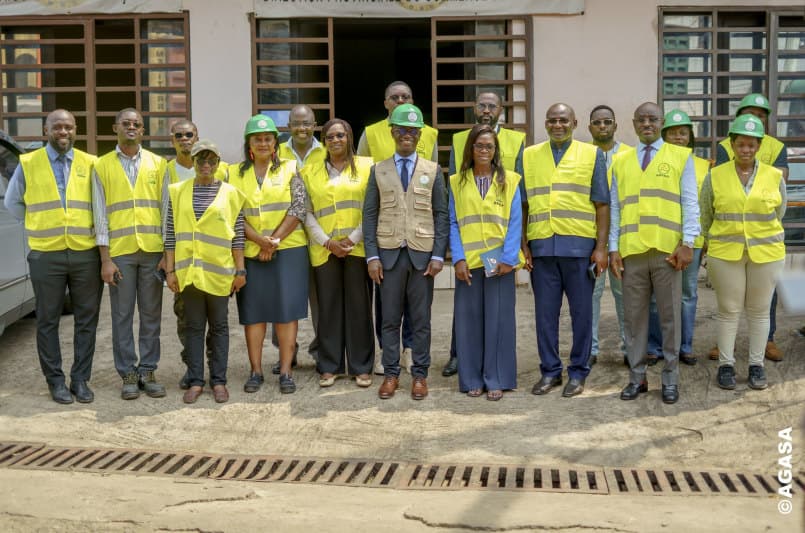

Created by decree n°029/PR/MAEPDR of February 18, 2011 and amended by decree n°0667/PR/MAEPDR of July 10, 2013, the Gabonese Food Safety Agency (AGASA) is a public establishment of a technical and scientific nature.
Under the supervision of Gabon's Ministry of Agriculture, Livestock and Rural Development, AGASA has legal personality as well as administrative and financial autonomy. As such, it is responsible for implementing, on behalf of the Gabonese State, public policy on food safety.
AGASA's core mission is built around three major pillars: prevention, assessment and management of health and nutritional risks linked to food intended for human and animal consumption. Its scope covers the entire food chain, from production to distribution.
The Agency also monitors and controls phytosanitary risks, particularly those related to plants (plants, seeds, fertilizers) and pesticide use, in order to protect consumers, animal health and the environment.

Our main objective is to protect consumer health by fighting against the marketing of food products unfit for consumption. Every Gabonese citizen has the right to access quality food, meaning food that is Healthy, Safe, Wholesome and nutritious.
Taking all necessary measures to prevent the appearance, aggravation or extension of a health and/or phytosanitary risk, or any situation (health or phytosanitary) that could be a source of harm to the health of consumers, animals or plants. To this end, health audits throughout the food chain and monitoring of health and phytosanitary hazards are a priority for DERSP in the areas of plant protection, animal health and food.
Implementing mechanisms to clarify the uncertainty related to health and phytosanitary risks and reduce it to a minimum. To do this, we carry out documentary checks on import and export files. The interpretation of risk assessment results must be done with a critical eye on gaps in knowledge or data, parameter variability, assumptions and choices that have been made.
An approach that consists of identifying the food safety problem and defining a risk profile. The risk profile should specify the aspects of the hazard that need to be prioritized to determine the risk assessment line, and the aspects of the risk that will allow the selection of safety standards and risk management options.